Gertrude sits on the front steps of No. 9 Adolf Hitlerstrasse with her sister. The light is long and pale on the rock faces of the Palatinate Forest, rising through the canopy of green the way bone and sinew rise through skin. This valley was here long before this village, Erfweiler, existed on it, and will be here after the last flag raised on it has rotted from its pole.
The Americans are billeted in the houses. The company morning report of the Anti-Tank Company, 222nd Infantry Regiment, 42nd “Rainbow” Division states their arrival into Erfweiler on March 23rd, and that they promptly set up anti-tank positions on the outskirts of town. In the two days since, the villagers have seen that they are young men, fed men, men with chocolate bars and chewing gum, and they move through the village with the confident ease of men who believe they are going to win.
One of them rides a white horse down the street.
He rides it across the freshly plowed field behind the house. The man who owns the house does not say anything. He lets him pass. The soldier looks at the steps, and the women sitting on them, as they watch him. He rides on.
And Gertrude does not know she has been chosen.
She has been chosen before. She is ten years old when the Reich decides what women are made for. She grows up in the Bund Deutscher Mädel learning that her body is not her own. It is functional. A vessel. The Führer’s investment in the future of the volk. In Gertrude’s world there is no red lipstick. No trousers, only natural shining hair and skin with that special Aryan glow. Domestic ambitions properly ordered: Kinder, Küche, Kirche. Children, kitchen, church. The Reich requires her health and her fertility and her silence on everything that is not her concern, which is most things, and her body is maintained accordingly, catalogued accordingly, directed accordingly, its purpose understood by everyone who holds power over it.
She is a secretary in a bureau, though the war has taken her role. She lives a few kilometers up the valley from Erfweiler, but the war has moved her out of her own house, away from her own street, into her sister’s borrowed room in a house in Erfweiler. It is a house full of people the war has displaced, people sleeping on floors and in borrowed beds and in rooms that are not their rooms, people learning to inhabit new geography while the war has given their homes to GIs.
The impenetrable wall that was meant to protect them is a few kilometers up the road. The Americans call it the Siegfried Line. The regime calls it the Schutzwall, the protection wall. In every cinema in Germany under Hitler’s order they show it, gnashing concrete teeth rooted in the earth, with concrete pillboxes sunk into the ridgelines above this valley. The word they learn and believe about the Siegfried is unbezwinglich. Unconquerable. They are safe behind it. Untouchable. The people in the villages near it live close enough to touch the pillboxes and the dragon’s teeth and the wire and they hear on the radio and see in the cinema that the line will not be penetrated.
Until it is.
The penetration of the wall does not happen in a singular event. It is a pressure system, a storm building inside a storm. A storm that builds inside the bodies of the villagers with explosions and rat-tat-tat of gunfire echoing around their heads all winter.
Since the autumn of 1944 that particular quality of sound, artillery rolling like thunder, ricochets in the hills for days. The villagers feel the vibration in the walls, in the floors, in the deep interior of their chest. By March of 1945 the line has been eroding for months, and the Wehrmacht are marched down from the ridgelines with their hands up and their helmets off. Nicht Nazi, they say, battle-weary veterans looping back into the front line in Germany, after months on the Eastern Front, with wounds still closing, men whose families have been killed in the bombing raids on the cities to the north, men who are there because the alternative is a wall and a blindfold.
The evening the Americans arrive in Erfweiler, a private writes home:
There’s a surprising number of girls here. This seems different to us because we are not used to seeing any girls whatsoever.
The unit has been in France for three months where the civilians hide in basements or flee, and there is nothing left after years of occupation.
Here the women are visible, standing in their doorways in a village under makeshift white flags waving in the cool air, where the pantries still hold food and the shelves still hold their things, and the war has only just arrived.
When the Schutzwall breaks open, the village is opened too. The ol’ Siegfried wasn’t what it was cracked up to be, the same soldier writes in the same letter.
Two days later a different soldier comes through on a white horse and watches the women on the steps and rides on. The men of his platoon know him only as Blackie, from Chicago. He is twenty years old and attaches to this platoon on March 25.
The same day he watches Gertrude on the steps.
He has four prior courts-martial and has been using drugs injected intravenously since before he enlisted. He has not seen a day of combat. He has not been on the forest floor of the Hardt Mountains calling out for his mother and medics who cannot reach him.
He takes the horse back to where he got it, then pulls guard duty from midnight until 0100. He finds two bottles of schnapps and drinks them.
He robs No. 11 first. He goes through the rooms waving his flashlight and his rifle and using his weapon to push the inhabitants around. He takes medals and a watch from a woman whose husband is missing on the Eastern Front, takes money he will burn later when he finds he cannot spend it.
Then he turns his attention to No. 9, a typical stone mountain house, the one where he saw the women. It is thick-walled, built to carry seasons and silence. The soldier has not been here long enough to know what typical actually is.
His path to the front door is lit by a nearly full moon. It is 3:30 in the morning and the street is the color of pale moonlight, but inside the house the dark is near total. The people have learned to contain themselves and the windows are covered. The coals in the kitchen are cooling. The light is extinguished. The house folds inward and into the slope of the land. The bread sits on the table. The eggs rest in their bowl beneath a portrait on the wall, prominent, its eyes fixed on the home’s inhabitants.
The soldier is another dark shape among dark shapes, something meant not to be seen. Down the street, a dog goes quiet.
Gertrude is asleep in the room to the left on the ground floor. Her sister is in the bed next to hers, her three-year-old daughter asleep beside her.
He raises his rifle.
He bangs on the front door with the butt of it.
The sound moves through the house the way a stone moves through water, through the walls, through the floorboards, through the bodies of the sleeping before the mind has caught up.
Gertrude is sitting up before she knows she is sitting up.
Every woman knows this moment. The body understands what the mind is still seconds away from naming. It is older than language, written into the nervous system by generations of being the one without the weapon, the one who learns to read the shift in air, the weight of a sound, the difference between a knock that asks and a knock that enters.
She can hear the two elderly men of the house talking low and fast, trying to decide what to do. One recognizes this soldier as the one on the horse in the field, and he opens the door.
The house changes.
Gertrude pulls her blanket up with both hands.
He blinds the men with a flashlight that he points at their faces; they can only see a silhouette behind harsh light. He moves past them.
The sound passes the kitchen.
The bread remains on the table. The eggs in their bowl. Above them the portrait receives the pale wash of moonlight coming through the opened door, the small, dark mustache over the indifferent mouth. And then the door slams shut and the dark returns.
His footsteps quicken and grow louder as he walks toward her room. The sound moves closer, wood under weight, steps that creak under weight that does not ask permission.
The men attempt to restrain him at her door. He pushes past them and enters.
He calls her a Hitlerite. He knows a little German, and he says in the language Gertrude understands: Now I give you Hitler.
He removes his helmet. He throws her blanket back and pushes her nightgown up to her shoulders. The beam of his flashlight blinds her as he moves it over her body, from her face to her feet, and back again. Then he grasps a fistful of her nightgown and tears it from her body. The back of it remains under her.
Her sister tries to stop him, and he hits her in the chest with the butt of the rifle. The sound is flat and hard. Her sister tries again. He hits her again but she screams: Gertrude! She screams for help from the old men just outside the door. The door is locked. She holds her three-year-old daughter, who is sitting still the way small children sit still when the world makes sounds they cannot understand, taking it in through the deep wordless tissue of the body that will hold it long after the mind has moved on, the way stone holds cold, the way bread holds the warmth of the oven without being asked.
The sound of a zipper in the dark is its own kind of language.
When he is finished, the zipper again. He pulls out a pack of cigarettes and offers one to her sister. Her sister does not take it. He offers one to Gertrude, who says later:
I took one fearing that if I did not take it he would do me further harm.
The match flares with a hiss. The room smells of sulfur. He draws on the cigarette and the paper catches, a small bright sizzle in the dark. Each time he inhales the orange jagged ember lights his face, the black hair, the black eyes, the slow curl of smoke around his fingers. Gertrude does not move. The child coughs once, a small wet sound, and her mother pulls her closer and presses her face into her shoulder. The two old men stand outside the door, waiting. The cigarette burns.
Outside, the valley remains as it was. The rock faces have not moved.
The helmet goes back on with a plunk of metal and leather. He walks out of the house. He aims his rifle at the moon and fires a shot into the dark. The sound carries through the narrow valley and off the rock faces and into the houses on the street. He returns into the night.
The house and the people in it do not return to themselves.
Gertrude’s sister opens the window and throws the cigarette butt out into the dark.
Gertrude takes the two pieces of her nightgown and places them on the kitchen windowsill.
The company morning report for March 26 states: Maintaining anti-mechanized protection.
A sergeant undertakes a different kind of protection. He comes to his lieutenant’s office and says: one of my men has property that does not belong to him, and he was AWOL in the night.
When the man they know as Blackie is brought in he tells them where the rest of the property he has stolen is hidden. He shows no remorse. He only says as his excuse, that a number of his buddies have been killed by the Germans. The statement signed describes the first robbery at No. 11, but nothing of Gertrude:
I climbed up on the roof between twelve and one o’clock on the 26th of March 1945. I removed a few bricks from the cabinet and climbed through the window. I went up to the attic and some old man came out and he and I went into this room where there was another old man and some women. I saw a suitcase lying on the table and started going through it. The stuff I took I put in the suitcase and I left. What she wanted, she grabbed and what she wanted and I wanted, she didn’t get.
The morning report for March 27 states that Blackie has been moved from duty to confinement in division stockade pending trial by Courts-Martial for looting.
Looting.
The trial convenes March 31, 1945, in Dahn, Germany. He pleads not guilty to all six specifications of robbery and assault. For the accused, no witnesses are called. When asked which of the three options he elects — to testify under oath, to make an unsworn statement, or to remain silent — Blackie says: remain silent. Very well, says the court. Take your seat.
The sergeant is sworn in and testifies that he finds the black briefcase and the medals and the jewelry in the accused’s possession and that the accused had been out all night without explanation.
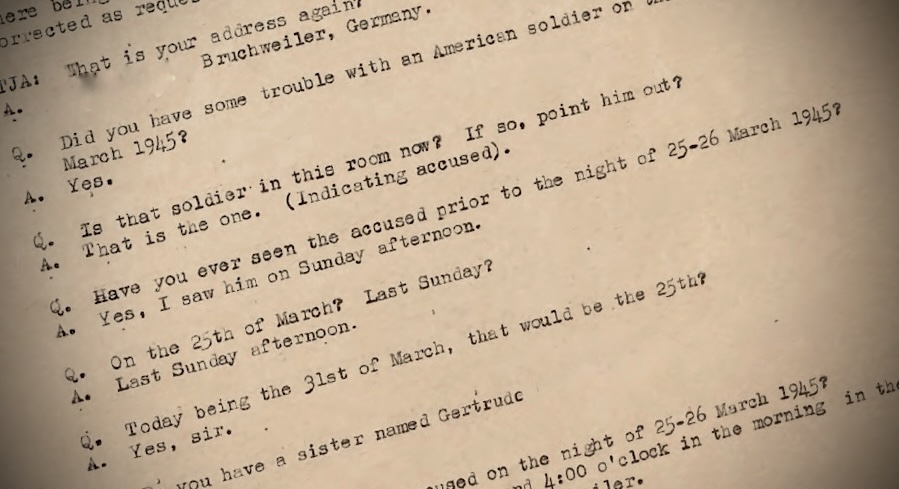
The women come one by one, sworn through an interpreter. Their testimony is typed onto paper, the typewriter’s high-speed clack-clack-clack, clack-clack punctures the atmosphere in the courtroom as it records the details of the assault. Gertrude spells her name for the record when asked: G-e-r-t-r-u-d-e. She points him out without hesitation. The soldier who caused me the trouble I have just pointed out. The one sitting in the middle there.
Her nightgown is in the courtroom, Exhibit E:
Ladies pink, cotton undergarment, torn.
She describes what he does in the dark room in the borrowed house on the street under the moon, and her words pass through the interpreter and into the typist’s fingertips and they are converted into testimony and the testimony into findings and the findings into a sentence.
Blackie is found guilty on all six specifications of robbery and assault. The sentence is reduced to twenty-five years. After his release, sometime before ten years of imprisonment, he leaves a paper trail of mafia crime: women harmed, FBI agents beaten up, bodies in trunks of cars. He is dead in 1970, killed in a hit by a mob boss.
Five days later, the sergeant who turns Blackie in and testifies moves his platoon through the fire-swept streets of Würzburg. A machine gun opens on him from point-blank range. Seriously wounded, he refuses medical aid, organizes his men and leads the attack. His body heals with one exception: a black fleck of rock from a street in Germany remains embedded and visible on the surface of his cheekbone for the rest of his life.
The twenty-two year old Gertrude steps out of the courtroom and the document trail on the last day of March 1945. She had a childhood that belonged to the Führer. Then ten minutes in the dark house that belonged to a private from Chicago who had been in her village for one day. Then her story belongs to a court-martial file stamped Confidential, later declassified, under Executive Order 13526, held in a box at the National Archives.
What she carries out of that courtroom, no file ever held and no file ever will. She carries it inside her like the black fleck of rock in the sergeant’s cheek.
The window stays open and the shell casing is on the front step and the cigarette is gone and the two pieces of her nightgown are on the windowsill and she is twenty-two years old and the clock tick-tocks on the wall and the eggs have been eaten and the bread is stale and the portrait has been removed from the wall and burned.