I walk out of the hotel, turn right, and head down the cobbled Riga street still drenched in lamplight. I see a familiar form waving at me from beside the white van that carries volunteers and bones back and forth across the Latvian landscape.
Over muddy fields and highways, this trusty van travels endlessly, ferrying the living toward the dead.
I smile and wave back. What we are about to do is my favorite thing in the world, and I am doing it with some of my favorite people in the world: the tight-knit community of volunteers that forms Legenda.
I climb into the front seat and say a warm, excited hello to the men in the van. It is a grand ol’ reunion. I have not seen these guys in months.
I am sitting next to Talis, the leader of the gang. He has been seeking the lost soldiers of Latvia for decades, working closely with the Latvian War Graves Commission, the Latvian government officials who issue the necessary permits, the landowners who allow Legenda to dig on their property, and the current governments of the fallen soldiers. Talis often reaches into his own pocket to pay for the equipment and fees necessary to exhume and bury the lost soldiers with a proper military service in a proper military cemetery.
Duksi is second in command and, like all the diggers, possesses a huge amount of knowledge about the war and its soldiers, equipment, battles, and politics. I constantly besiege him with questions, and he always provides the answers.
I love this ragtag gang of diggers like brothers.
The digging community of Legenda is straightforward, no bullshit: get out there and dig, help each other as you go along, eat and drink together all evening, then start again.
After a cheerful round of catching up, the guys fill me in. On this exact day, December 30, in 1944, a harsh battle raged between the Red Army and the Germans, with Latvians fighting each other on both sides. On the field where we will go with our shovels, around two thousand Latvian men who served in the Red Army died.
They rested in peace for months in piles stacked around the battlefield. The German Army had gathered its own war dead, but the Red Army had not. When the springtime thaw came, the women came to identify the bodies of their sons, fathers, brothers, and husbands. The bodies they identified were taken home and buried. Those not identified were hastily buried in unmarked mass graves.
Today we will look for those soldiers.
The Soviets occupied the country in 1940. Latvians were subjected to massive oppression, including executions and deportation to Siberia en masse. Because of this, when the Germans rolled over the border in 1941, many Latvians viewed them as liberators.
There was, and still is, no one true Latvian path through those war years. Jewish Latvians were forced to march to their deaths along the old highway, into a forest where executioners waited with guns. Some Latvians pulled the triggers that sent their Jewish countrymen tumbling into mass graves. Some were forced into the ranks of the German Army as members of the SS Latvian Legion. Some signed up willingly and proudly wore its death’s head insignia. Many died in the name of Communism, some forced to fight for the Red Army and a regime they did not believe in. Others fought proudly for the Red Army and carried their victory into the next iteration of Latvian history.
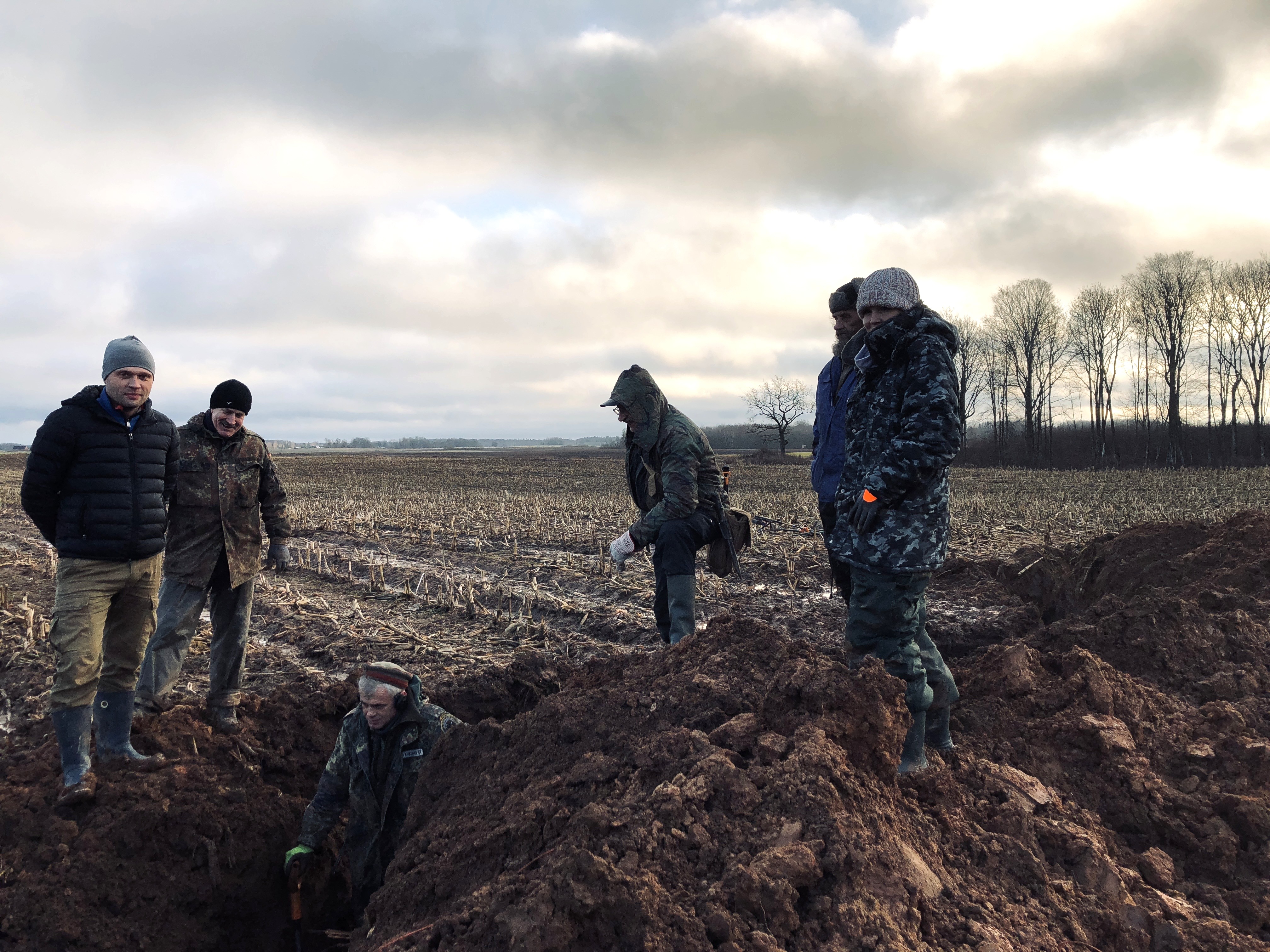
The sun is still rising at nine in the morning and sits behind a thick layer of clouds when we set up base camp. One by one, the men march off, shovels and metal detectors over their shoulders, hats on, smokes out, ready for a long day and filled with high hopes of finding a soldier who can finally be sent home.
A whip of the wind bites at my face, the only exposed skin on my body. I wear a pair of heavy synthetic-leather gloves I bought the day before at a Latvian version of Home Depot. Occasionally I free my right hand to take photographs, but skin freezes quickly in these conditions. Taking to heart the warnings about frostbite, I mostly keep it inside the heavily cushioned glove.
Whenever Talis sees me, he calls me over in his thick accent. “Amer-ee-kuh!” He pulls off my gloves, checks that my hands are warm enough, and slides the gloves back into place.
There is mud everywhere and the sound of the tractor groaning, while men roam the field and the clusters of trees dotting the landscape, their positions given away by the beeping of metal detectors.
The soldiers wore various types of metal on their uniforms and carried metal items in their gear. The beep of the detector gives a clue that there could be a soldier lying under its sweep.
Under a dull and dense sky, the earth churns forth the evidence of war: bullet casings, cartridges stuffed full of glistening gunpowder, helmets, communication wire, shrapnel-shredded meal tins, grenades, pieces of a gun, and a tiny gold star from a Red Army officer’s shoulder board. All of it has been buried for more than seven decades, decaying in the earth and quietly holding a story of humanity’s inhumanities.
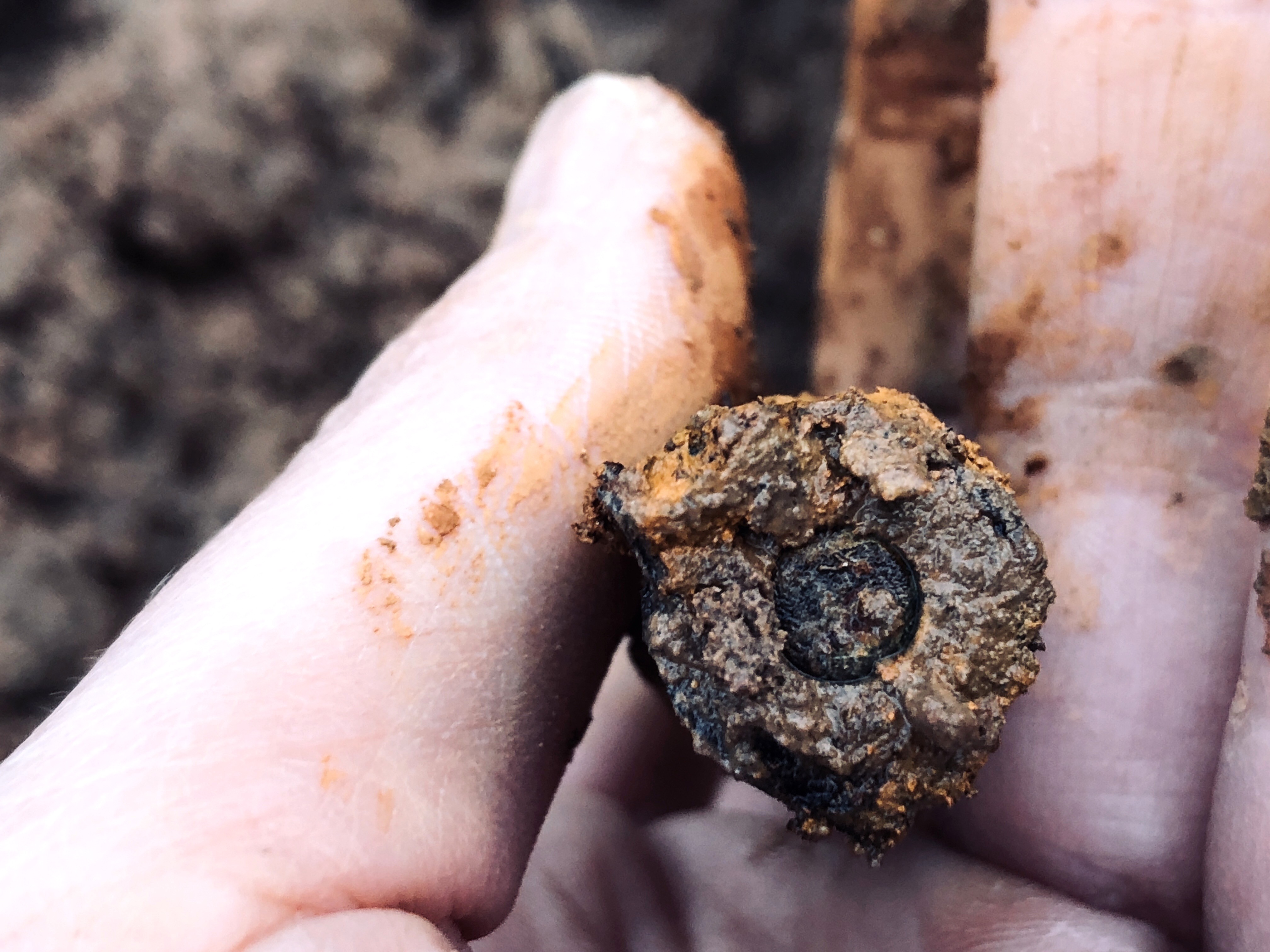
Removing anything from a site where a soldier is found, or from the soldier himself, is considered grave robbing. It is strictly forbidden and carries severe consequences. This is solidly upheld, a foundational sacrament of Legenda, with zero tolerance toward anyone who falls out of line.
I wander away from the group and enter a petite, narrow forest where fallen trees, moss, a huge puddle of water, brambles and branches cover the ground. I hunch down and take photographs of the marks made by bugs eating the curling tree bark, peeled off in wide swaths and undulating across the ground in every direction.
I think of the men.
I think of the men who were sponges for propaganda from tyrannical governments and held their fight with fervor, and the men fatigued by oppression who craved a simple kind of peace, and the men who did not want to be here, dying for something they did not believe in. All of them carried guns onto the same field, mutually existing as killers on the front lines, hell-bent on surviving this damn war.
I think of them as fathers, lovers, shopkeepers or scholars, men who may not have even had two decades under their belts.
I think of the women waiting for their men to return in one piece, wondering if they had enough to eat, if they were warm at night, why they had not written, if they had been killed.
The women combed this field in the spring of 1945, looking for the bodies of their men among the piles of rotting bodies the Red Army left behind. Were tears spilling out of their eyes, or had they run out of tears? What about the woman who did not find her man? What did she do when he never came home?
Duksi tells me about a Red Army soldier they dug up from this same field during an earlier search. They had found a medal from his uniform with a registration number on it, so the guys were able to work with the Russians to trace his identity. The Russian government found his daughter, still alive, in Russia.
She remembers being a young girl and sitting on her father’s lap the day he went off to war. Then nothing, for many years, until these diggers, with their crusty metal detectors, set out across the field and found him beneath it. She watched him leave, and he did not come back. She was able to bury him when he came back seven decades later.
Duksi often pretends that he cannot speak English, but what he says next proves him wrong.
“You are not like other people, Erin. I can see it in your face. The way you look at the battlefield. You don’t just stand here today, right now, and look at what there is to see. You feel the history.”
He moves his big hands through the air and makes the sounds of anguish, artillery, explosions, and shooting guns. Then he stops and looks at me.
“You experience it like it was happening here, right now.”
“Yes,” I tell him. “That is all true.”
·
We dig for hours. To think of the thousands of men still lying under our feet, waiting to be exhumed and returned home if they can be identified, is mind-boggling. A sense of awe rushes through me. With every shovelful of dirt there is the hope of finding a soldier.
We find no bones and no soldiers that day.
The sky begins to darken as the sun slides down rapidly. The tractor turns back, and so do the men with their gear. The Latvian sun is straight ahead, just above the horizon, still hidden but trying to peek through the clouds.
“Amer-ee-kuh!”
Talis waves for me to follow him as he goes to retrieve gear from the field. I walk behind him and watch my feet muck through the mud, feeling it pull heavily on my heels. There is a cob of rotten corn, a delicate skeleton snapped in half by the heavy footfall of one of the guys. I hear the tractor behind me, finding its way back to base camp.
Talis points to a gnarled piece of machinery they pulled from the earth and tells me about it in a mixture of Latvian and German. I smile, nod, and ask what I can. He soon walks away, satisfied that he has somewhat shared his knowledge with me.
Then I am alone on this vast field.
The sun breaks through the clouds, joining me and the still-hidden soldiers on the battlefield. Quite suddenly there are streams of the brightest light beaming every which way.
I pick up the gear and walk back to meet the guys, soaking up the presence of beauty spilling out of history’s ugliness.
·
Somehow, when you find a piece of a fallen soldier, you find a piece of yourself, as if a part of you, too, was hastily buried in an unmarked battlefield grave.
When you gather the bones nestled in the earth, something clicks inside you and puts you back together. There is a visceral, palpable connection between you and the bones in your hands, a sacred union with the remains of this human that has no words and remains a secret between you for all of time.
It changes you, inside and out. You long to share it, to tell it, to describe it, but you cannot. So you return again and again, to gather the bones.
·
There are still an estimated one hundred thousand missing soldiers in Latvia.
The white van will leave Riga again and again, ferrying the living toward the dead.